Our Research
Cancer and Ferroptosis
Ferroptosis is a type of cell death that is induced by the accumulation of oxidative stress and sequential lipid peroxidation. This novel form of cell death, characterized by its distinct mechanism, may offer therapeutic benefits, including the potential to target tumors that are resistant to conventional anticancer treatments.
The rapid proliferation and metabolism of cancer cells renders them more susceptible to oxidative stress compared to normal cells. To ensure their survival, cancer cells fortify their antioxidative defense systems, thereby protecting themselves from ferroptosis. In addition, recent studies have indicated that this enhancement of the antioxidative defense system is also implicated in the development of treatment resistance.
It is imperative to acknowledge that ferroptosis does not merely occur "by increasing reactive oxygen species." Cancer cells possess a defense network, or antioxidant system, consisting of multiple pathways, such as xCT–GSH–GPX4. In order to overcome these defenses, a strategic approach is necessary.
A Development Strategy for FerroptoCure, with the Focus on Ferroptosis Regulation
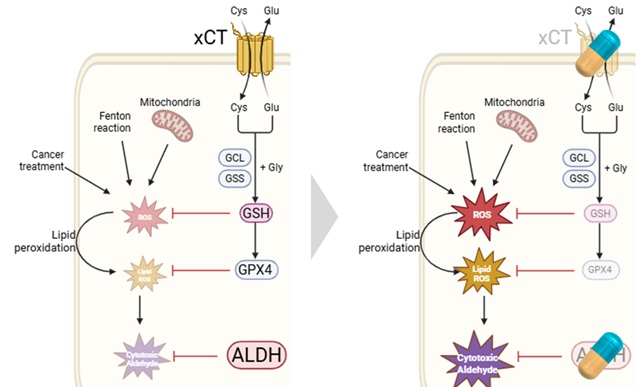
FerroptoCure has elucidated a key antioxidative system in cancer cells at the molecular level through its proprietary research*1, 2. In light of these distinctive findings, we are developing a first-in-class, orally administrable small-molecule compound that utilizes "ferroptosis-induced synthetic lethality" to simultaneously inhibit the two key molecules—xCT and ALDH—of the antioxidant system on which cancer cells depend. This mechanism functions through a pathway that is distinct from apoptosis or immune-mediated cell death. It has the capacity to target mechanisms that are indispensable for cancer cell survival across a variety of cancer types.
1) xCT–GSH pathway
In treatment-resistant cancer cells, a significant amount of cysteine is taken up via a transporter called xCT (SLC7A11). This process results in the production of glutathione (GSH), a potent antioxidant. GSH has been shown to directly neutralize reactive oxygen species and to prevent lipid oxidative breakdown through an enzyme called GPX4. This pathway functions as a central survival mechanism for cancer cells that are exposed to an environment of chronic, intense oxidative stress.
2)ALDH Pathway
the ALDH pathway is of relevance in this context. As lipid oxidation progresses, toxic lipid aldehydes such as 4-HNE and MDA are produced. Cancer cells employ the enzyme known as ALDH, which is also referred to as aldehyde dehydrogenase, to detoxify these compounds and thereby avoid potential damage.
FerroptoCure, a Japan-based organization, is spearheading the practical application of ferroptosis-based drug discovery. This initiative is supported by a research infrastructure that includes selection for AMED's "Drug Discovery Venture Ecosystem Enhancement Project".
*1: Okazaki et al., Oncotarget 2018, DOI: 10.18632/oncotarget.26112
*2: Otsuki et al., Cancer Science 2020, DOI: 10.1111/cas.14224